
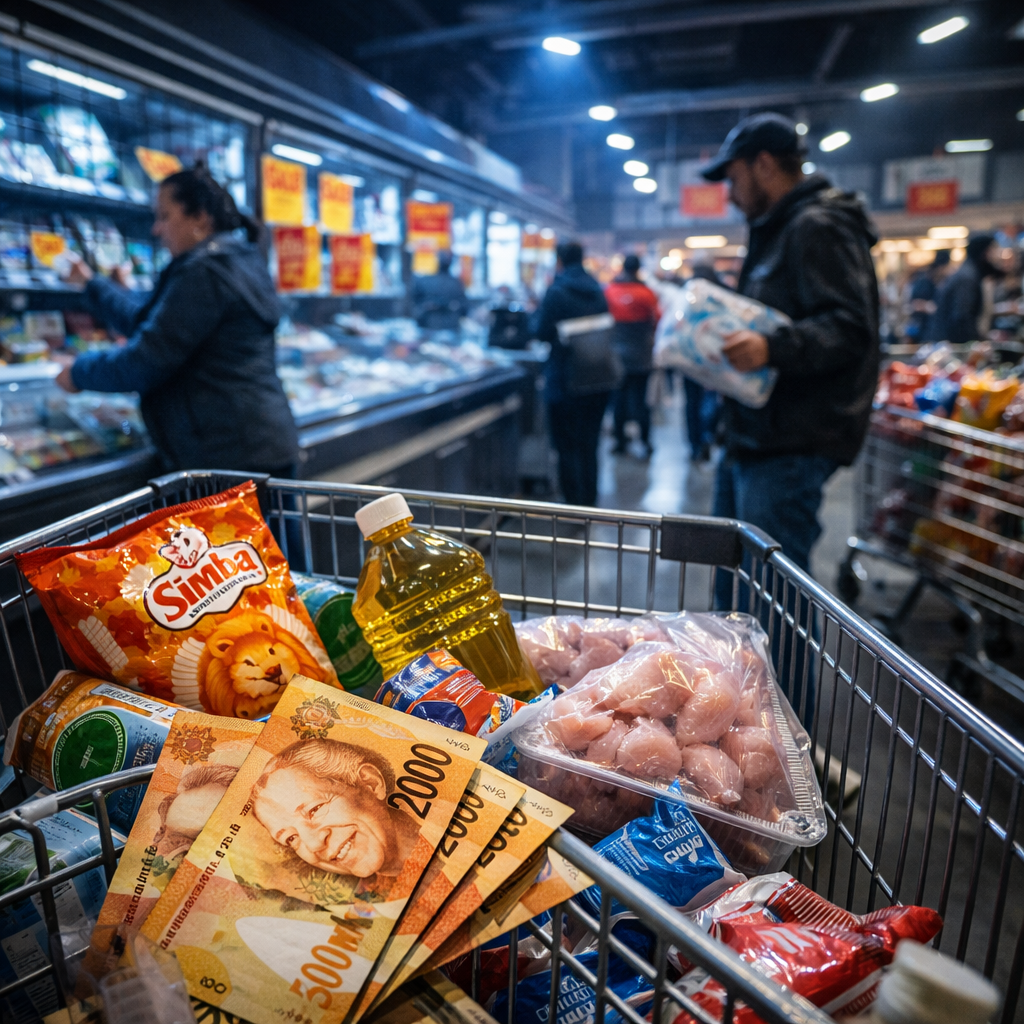
Shoprite says it delivered about R9.7 billion in customer discounts as its revenue rose 7.2%, signalling that aggressive price-cutting — rather than higher ticket prices — was a major driver of sales growth while consumer budgets remain under pressure. The retailer absorbed more input-cost strain and its trading margin eased to 23.8%, showing that it effectively “paid” for lower shelf prices through thinner profitability.
The core news event is intensified grocery price competition in an inflation-sensitive market, with a major retailer choosing to protect volumes by discounting heavily. For South African households, the immediate direct cost impact is felt at the till: fewer rand are required for a similar basket than would have been the case if Shoprite had fully passed through supply-chain and operating cost increases. In practical terms, this can mean a family that spends R4,000 to R6,000 a month on groceries and household essentials sees more items on promotion, more stable pricing on staples, or a narrower gap between branded goods and house brands.
However, margin compression matters because it can limit how long deep discounts can be sustained without knock-on effects. If input costs keep rising — from transport, utilities, packaging, or wage bills — retailers eventually have to choose between lifting prices, reducing promotions, or trimming costs elsewhere (for example, range reductions, smaller pack sizes, or slower expansion). For consumers, that translates into uncertainty: today’s cheaper baskets may not automatically carry through if the cost base doesn’t ease, particularly on categories that track commodity prices closely.
The near-term takeaway for the average shopper is to treat the current discounting cycle as an opportunity to tighten household budgeting: plan shops around known promotion periods, compare unit prices (per 100g/ml), and consider switching to private-label alternatives where quality is comparable. The longer-term signal is that grocery inflation may feel less severe at Shoprite right now, but the reduced margin suggests there is a ceiling to how much further retailers can absorb costs before price increases reappear more broadly.